I would like to dedicate this article to my professor Claus Kiefer, who I see inspiration in his continuous work to finding a Quantum Theory of Gravity.
Liberation
“I’ve always believed in numbers and the equations and logics that lead to reason. But after a lifetime of such pursuits, I ask, “What truly is logic? Who decides reason?”
My quest has taken me through the physical, the metaphysical, the delusional — and back.” – John Nash
This journey that I shall accompany you on, is one only few dared to set sail for. It is a journey into the unknown, into a realm of the physical and the metaphysical. It requires man to give up on what is intuitively logical and reasonable to him. It demands an encounter with complex questions that are beyond our comprehension. What is it like to venture into the beginning of the world, into the beginning of time and space themselves, to set foot on a whole new world of absurdity, a world that has no grounds, and where time ceases to exist.
For a long time this pursuit was regarded as futile to be tackled by a simple mere man. The key to these ultimate questions was in the hands of the Gods who refused to share their wisdom.
For a long time this man was left in the dark, in a lonely Universe that extended for millions of light years across. But as he gazed into the silent night sky, he saw a glimpse of light way beyond the stars and the galaxies, a faint dot wandering across the cold dark cosmos for billions of years. He mounted his telescopes, reached up and grasped it, and behold, it was the long-sought-for key of wisdom, right there in his palm, he shivered and his heart quivered, realizing that for so long he has been living in a glass cage, he could see the whole world, but never challenged himself enough to explore it. He shattered the glass, set himself free through an expedition to find the door to ultimate knowledge. Ever since then, he has been lost venturing through this cold dark cosmos, he holds the map, he has the key, he just doesn’t know how to use them and where to steer his path.

Aspiration
Venturing into the unknown can lead to great rewards- Antichamber
Our story is an old one, prolonged over thousands of years of human desire and will. The moment we opened our eyes to the world, we couldn’t stop looking forward and above, asking questions about creation and existence. We fell through many pitfalls, sometimes even had to start from scratch, but here we are today, millenniums later, focused on what was once a humble beginning by our predecessors. We’ll skip the first thousands of years where humanity was somewhere in some kind of limbo, going through the metaphysical world where cosmology was fairy tale, and jump directly to the 20th century where this fairy tale became a physical reality.
[ If you are interested in the history of cosmology and ancient cosmological theories, I recommend the following book – Chapter 1 : Foundations of Modern Cosmology. ]
The universe, static and eternal, a piece of art painted above our heads. That’s how the world charmed this celestial sphere. But hidden behind the trees and above the clouds, one man was sketching a more artistic picture of the universe. Every night he sets up his canvas, takes a pencil and gazes out there at the night sky tracking the motion of stars twinkling on his pupils as he looked at them through the biggest telescope in the world. His name was Edwin Hubble, and what he’s about to discover will lay the foundations of our story.
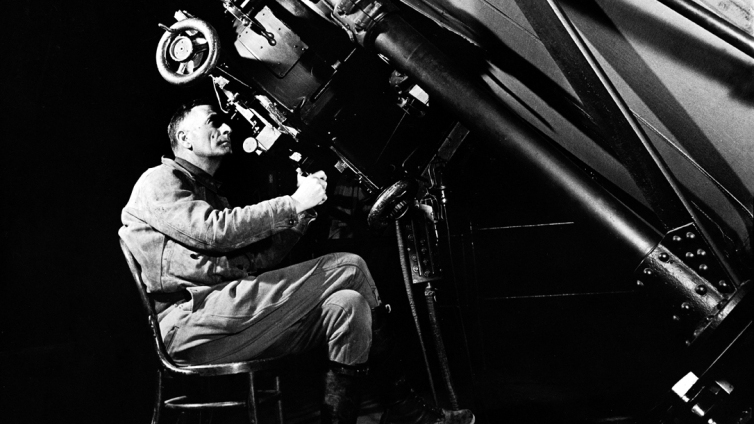
American astronomer Edwin Hubble looks through the eyepiece of the 100-inch telescope at the Mount Wilson Observatory in Los Angeles, 1937. Margaret Bourke-White/Time & Life Pictures/Getty Images
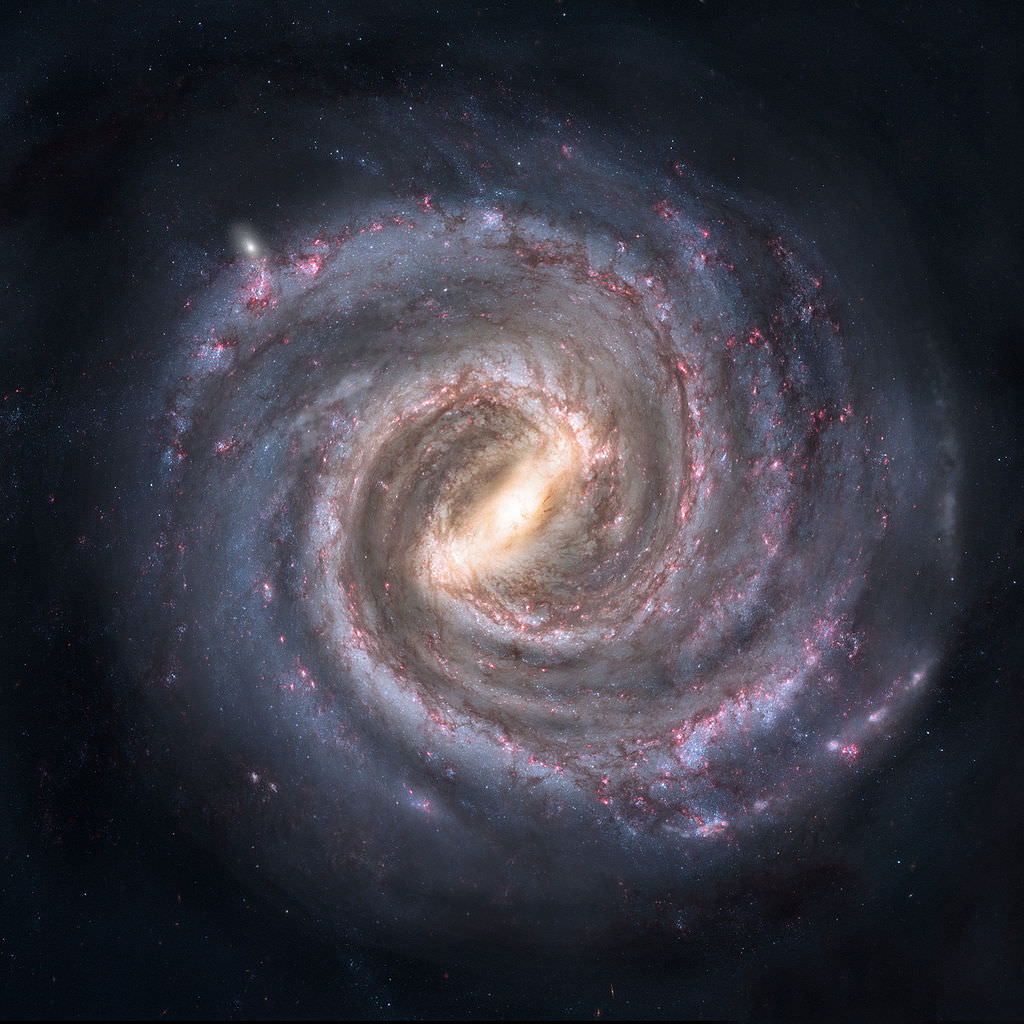
Hubble was one of those thousands of astronomers around the world who wondered what these fuzzy clouds of light in the night sky are. For a long time there was no consensus as to whether these patches of lights were formed by stars in our Milky Way galaxy, or whether they are from a different universe altogether, an ‘island universe’ floating in the ocean of space. The entire universe before Hubble’s work was constrained in the Milky Way galaxy that contains billions of stars. Never have we thought there is a bigger world out there, beyond our scope, and that the Milky Way galaxy is just one out of billions and billions of other galaxies, that together, make up the entire universe.
In 1924, Hubble published a paper, telling the world that we are not alone, and what we once thought was the universe is just a small fraction of it. What Hubble has been observing for a long time weren’t stars in our Milky Way, but stars in other galaxies millions of light years away from us. The Earth, the Sun, the solar system and the entire galaxy, are just a spec in this whole new picture of the cosmos that Hubble drew for us.
But Hubble didn’t tell the full story yet, he hid a secret from the world, something he couldn’t share only 5 years later, the beginning of the story.
In 1929, Hubble revealed the shocking secret, not only is the universe bigger than we have ever imagined, it is getting bigger and bigger every second. According to the data Hubble has been collecting, the universe is actually expanding !
This discovery had a huge impact on the whole world in general and the scientific community in particular that believed in the Steady-State model, a theory that claims that our universe is static. It was widely supported by scientists, most notably Einstein, who built his field equations in manner that made the universe purposely static. Technically, he added the famous cosmological constant λ . It didn’t take long until the news spread and Einstein heard about Hubble’s revelation, and did not hesitate to agree with the discovery, and later call his addition of λ his biggest blunder.
An expanding universe meant only one thing, that the universe had a beginning and is not eternal. Why is that ? Imagine an bubble expanding as time passes by, where every point on the bubble is an entire galaxy. Now run the movie backward. What you’ll observe is a contracting bubble, galaxies coming together, fast backward and you’ll reach the beginning, a single tiny dot, where it all started. This realization was the birth of modern cosmology.
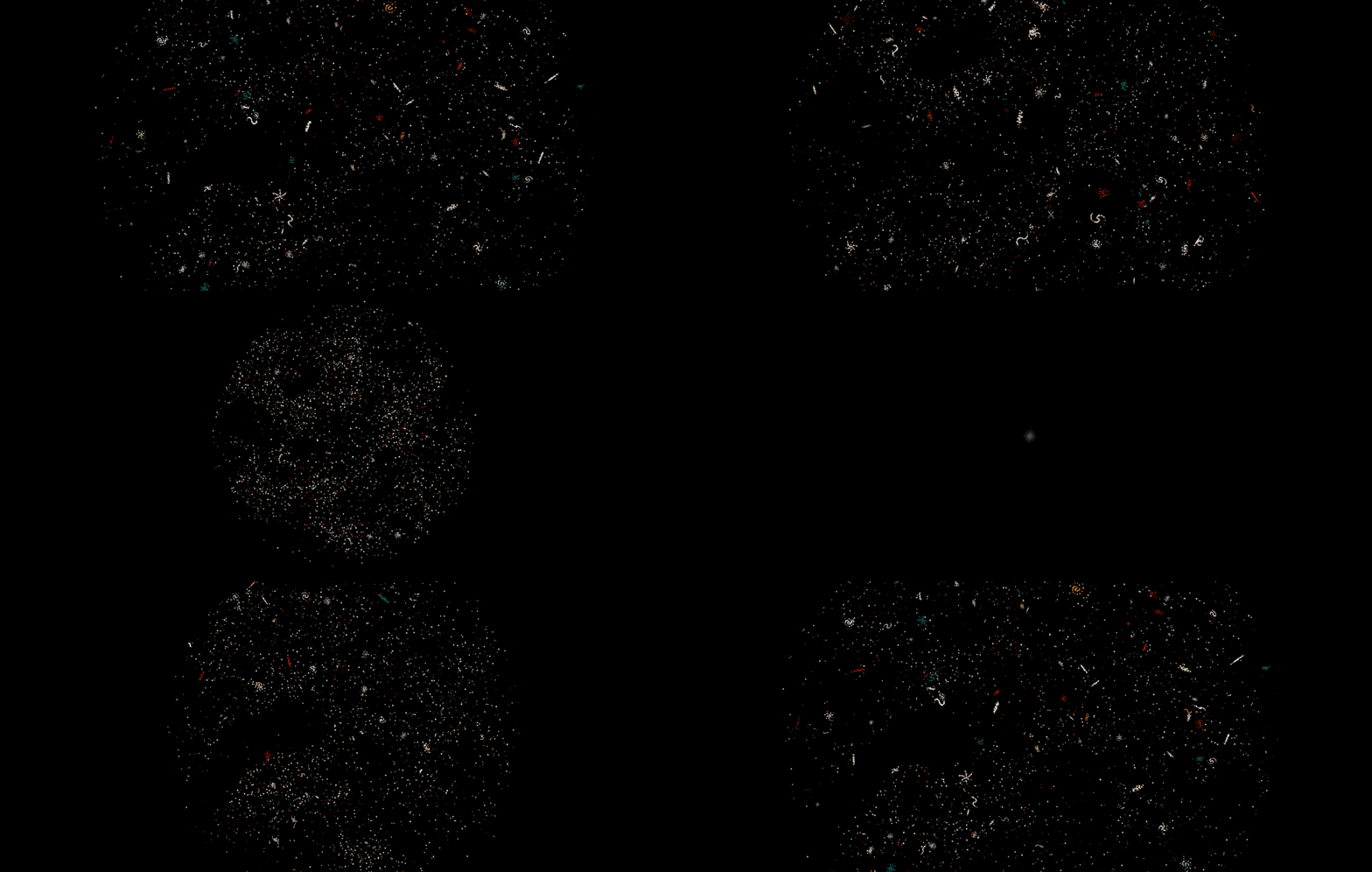
davidope (for Quanta Magazine)
The universe, this collection of stars, billions of them making up galaxies, and billions of galaxies making up clusters-(a collection of galaxies), and millions of clusters making up super-clusters. This universe is unimaginably big, extending billions of light years across, and it’s been doing so since it was born, from about 13.7 billion years ago, when it all started with what we call the Big Bang.
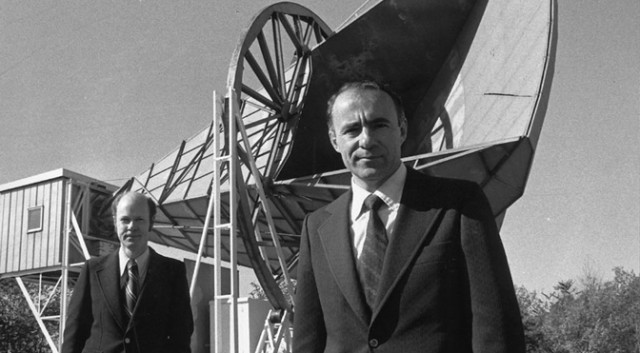
The story doesn’t go untold without talking about Penzias and Wilson. They are two astronomers who, by a funny twist of story, captured the signal we talked about in the beginning of our story, that faint light that was traveling through the cosmos since the beginning of time. The story goes like this: Two astronomers were looking out into space through their 6 meter radio telescope, collecting radio signals from galaxies in hope to study some of their properties, however the data they collected was very bad, in a sense that it had a lot of noise and it wasn’t clear what they were observing. The telescope was situated near New Jersey in the United States, so they thought it was signals coming from the city, and tried to subtract that noise. They redid their experiment, but in vain, the signals are still noisy. They thought and wondered why this could be ? And Eureka ! They realized that there were two pigeons flying around everyday and they had their homes built inside the telescope, and it was probably their droppings which are causing this noise. They tried to shoo the birds away, but no luck, they kept coming back. “To get rid of them, we finally found the most humane thing was to get a shot gun…and at very close range [we] just killed them instantly. It’s not something I’m happy about, but that seemed like the only way out of our dilemma,” said Penzias. Sad as it might be, but they had no other choice. They climbed up the telescope and scrubbed every part of it clean and shiny. “We’re onto a discovery now!” That’s what Penzias and Wilson were waiting for. They ran the telescope, and.. Noise kept on coming from every single direction. Frustrating it was, the two astronomers took a break for thought, trying to figure out why, what are we missing?
At the same time of their struggle, other scientists were also trying to build up on Hubble’s discovery. Princeton University physicist Robert Dicke had predicted that if the Big Bang had occurred, there would be low level radiation found throughout the universe. For example, our Sun is constantly emitting radiation, but this radiation (light) takes time to arrive from the Sun to us on Earth, approximately 8 minutes. So when you look at the Sun right now, you are actually viewing it 8 minutes in the past! So Dicke predicted if the universe had a beginning, we should be able to observe it through some kind of radiation, microwave radiation to be specific, that has been travelling to Earth since the beginning of time. Penzias and Wilson heard about this hypothesis, and did not hesitate to test it. They reran their telescope, and goosebumps! The noise was actually the microwave radiation Dicke talked about. This “noise” was the leftover from the creation of the universe.
Today we call this radiation the cosmic microwave background radiation a remnant of an early stage of the universe, the oldest piece of art every painted.

[ “Well boys, we’ve been scooped!”.
Dicke was actually planning to build his own telescope to capture this microwave radiation, the Dicke Radiometer, after all, it was his idea that this radiation should be there, but Penzias and Wilson tested Dicke’s idea before he finished building his telescope, and so the discovery was attributed to Penzias and Wilson, and where they shared the Nobel Prize for their discovery, and Dicke was not included. And so Dicke said to his scientific team :”Well boys, we’ve been scooped”, scooping means to have someone take your scientific ideas and publish a paper on it before you and get credited for it.]
The universe had a beginning, and it has been growing in size ever since like a living seed. The universe is truly alive, in a sense that it is dynamical, it was born and one day it will die just like everyone else. No wonder why we saw the universe so fascinating, we relate to it, we are part of it as much as it is part of us. The only question still remaining, who gave birth to it ? Who planted this seed ? Whether this question has an answer or not is still unclear, but for now, our only hope is to go with what we already have, and the knowledge that we’ve spent centuries accumulating, and have faith in the scientists who have been giving us answers to all of our questions, and empirical evidences to all our doubts, to those millions of people around the world who are working to make our life easier and more understandable.
Our beginnings were humble, we started out as foragers and hunters. Crossing the oceans seemed to us like an impossible task, and the moon was a place we visited only in our dreams. Today we’ve crafted ships and various water vessels that made us conquer the seas, designed spacecrafts and rockets that took man to the depth of the unthinkable. We kept pushing our limits, but how far can our brilliance take us? Today we’ve reached the edge of our knowledge again, going in circles and loops ( literally ) the same way our ancestors reached the shores and called it an edge, went back and came again daring to cross it until they figured it out. So can we push our limits once again, challenge ourselves and open up an entire field of exploration, discover a world beyond the beginning of the universe? This is what we seek for today, and this will be our next chapter.
Quantum Cosmology
The search for a consistent and empirically established quantum theory of gravity is among the biggest open problems of fundamental physics.
– Claus Kiefer
“Is this the beginning?” We asked. We gazed so deep into the night sky, until we reached the edge of sight, the limits of our vision. Is there anything beyond the horizon ?
The cosmic microwave background radiation is a barrier, a stop sign telling us to go back as there is nothing to see here. You see, the beginning was dark, the universe was unimaginably hot and unimaginably small, there were no stars, no galaxies, nothing but a hot dense soup of particles aimlessly travelling and bumping into each other in this small sized volume of space, that not even light could travel around. It wasn’t only 370,000 years after birth did the universe cool down enough to allow the propagation of light, and it is this light that Penzias and Wilson detected.
The beginning is there, it is just barricaded by a wall of fire that not even our biggest telescopes can penetrate. How can you see what is happening in a dark room? How can you study anything if there is nothing to see? We desperately needed an answer, it’s been a long way and the answer is just behind that wall. We had no choice but to take a leap of faith, jump into the void, and blindly wander into a world so small that everything we know is no longer valid, a world where the laws of physics as we know them break down. This is the world of quantum cosmology, an attempt to understand how the universe behaved when it was a baby, when it was so young that particles no longer behave classically, when space-time itself no longer behaves classically.
For a long time now we have known how to work in the world of the very small, we have cracked the atoms open, understood their structure to their tiniest particles and the forces that hold them together. This is the world of Quantum Mechanics. It is a bizarre world, mythical yet seems very actual as it passed all the tests and experiments we could think of so far. It tells us how particles interact, how they form and pop out of existence from nowhere, how they are everywhere at once, and how silly we are if we ever thought of making sense of it. And if we ever dream of getting a glimpse of understanding of the beginning of the world, our only hope is through quantum mechanics and quantizing gravity. What does that mean ? As I mentioned earlier, quantum mechanics is the science of the world of the very small, of the subatomic particles and the basic building blocks of matter, which is happening all around us and across the universe, from the photons (quanta of light) that hit your eyes, to the millions of cosmic particles that are passing through your body every second. But now imagine with me here, if this world itself, is very small, if the whole universe is of the size of an atom, how would it behave ? Will the universe pop in and out of existence like a quantum particle ? Will the universe even make sense to understand it in the first place? This is what we aim to understand, how the universe behaved right after it was born, when it was of the size of a tiny particle, and it is one of the ultimate questions that physicists today try to tackle, and which so far failed to achieve.
At some point things start sounding ridiculous and unrealistic, dealing with length scales that are billionth and billionth of times the size of an atom, that’s 0.000000000000000000000000000000000016 meters! This number is known as the Planck’s length: lp= 1.6 x 10⁻³⁵ meters, it is the scale at which quantum effects of gravity becomes apparent. In other words, it is the scale at which the universe was a baby, and at which it stops making sense. You truly enter the world of the metaphysical at this point, some talk of a world of extra dimensions, and existence of structures beyond the subatomic world they call strings, others talk of loops, and some completely abandon the concept of gravity as a fundamental force of nature.
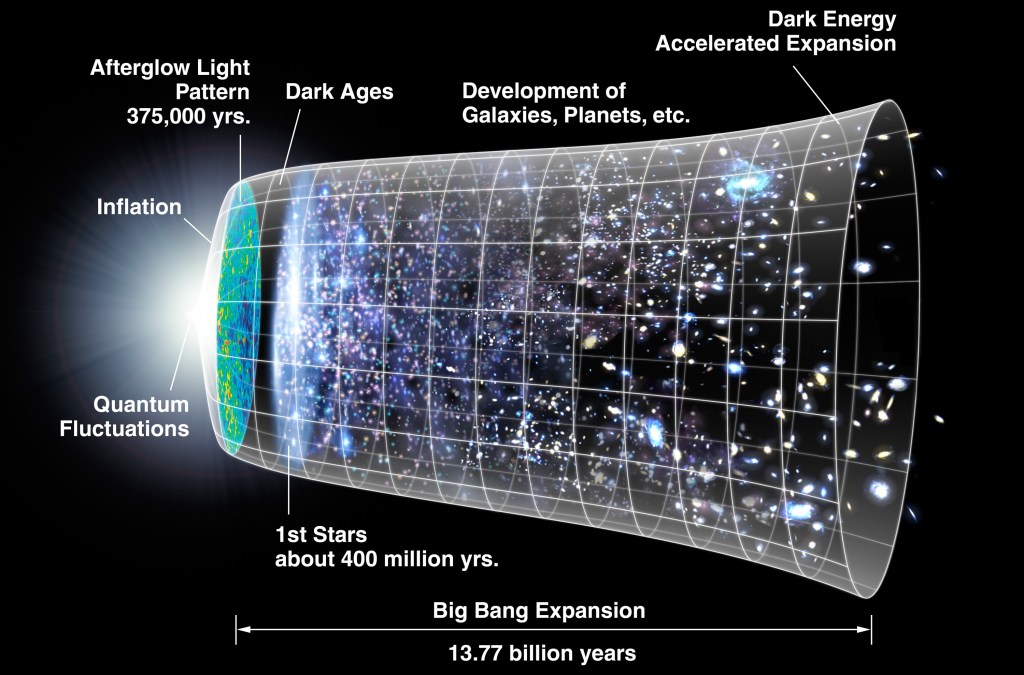
The figure also shows the CMB 375,000 years after the beginning, the edge of our sight. NASA/WMAP Science Team
One thing we are sure of, is that there are inconsistencies in our theories, whether our understanding of the world of the very small ( Quantum Mechanics/ Quantum Field Theory ) is wrong, or our understanding of the world of the very large ( General Relativity/ Cosmology ) is. The two simply don’t go along together, and if we hope to get a good picture of how the beginning of the universe looked like, we have to reconcile the two somehow, we have to find a theory of quantum gravity.
Many around the world have accepted this challenge, have set sail into this new world, some have spent a life time already, finding new routes and roads but never made it to the beginning.
The end of our story is literally the beginning, and whoever docks his sail will be a hero who’s memory will live on forever.
“ …how vulnerable the repository of all our potential once was, how perilous our infancy, how humble our beginnings, how many rivers we had to cross before we found our way.” – Carl Sagan
 Ali Lezeik
Leave a comment