
Credit: https://blog.apaonline.org/
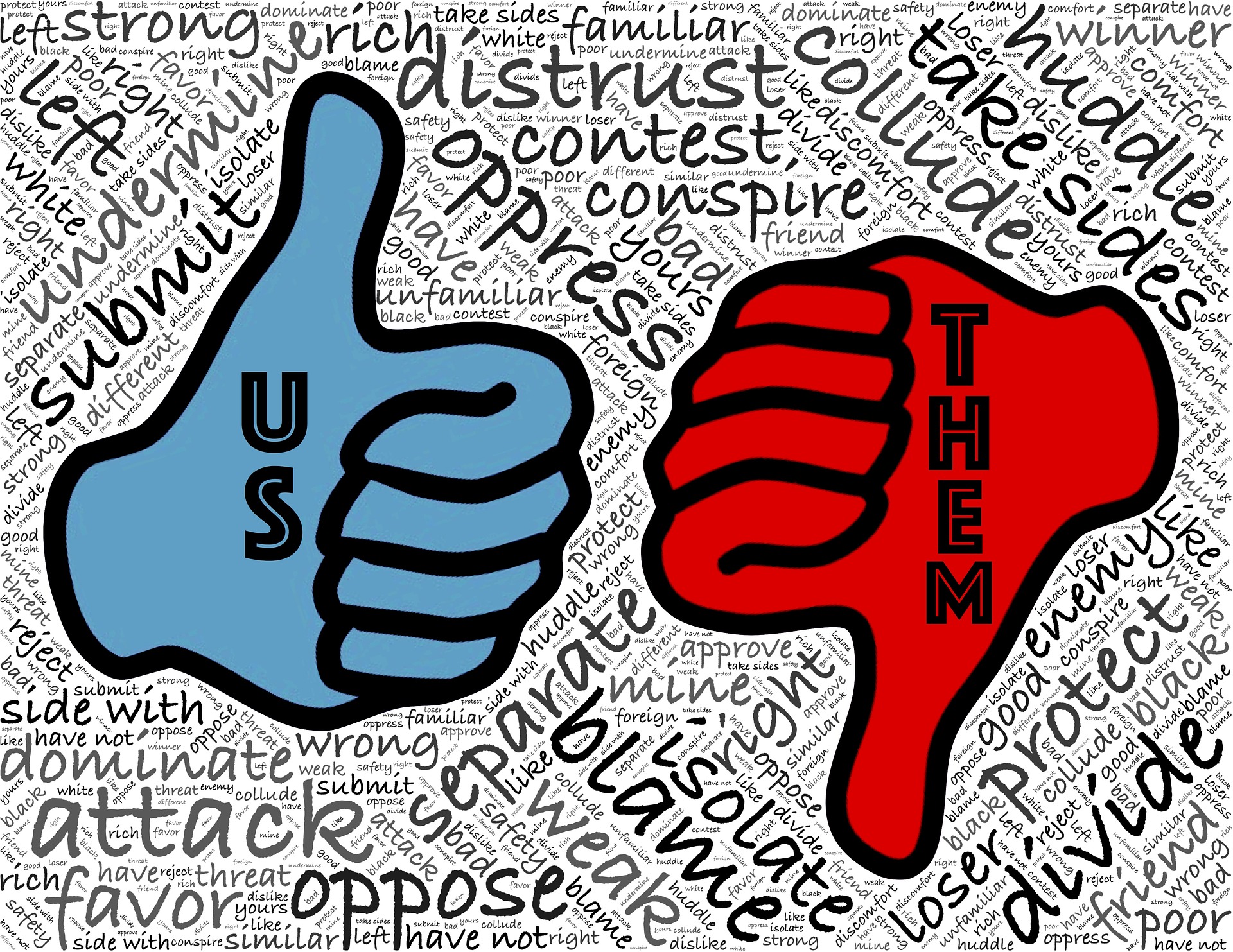
In this world of many cultures, religions and societies, ideologies vary, and as a result we tend to collide with one another, arguing against those who are different, in favor of those who stand in our stance, a stance which is one in thousand others.
I would like to discuss my personal view on ideologies, and despite its importance in giving us a unique feature, an identity of some sort, it is also a destructive tool in dividing people and leading to a cultural gap than can never be reconciled.
Groups, Subgroups, Subsubgroups, subsubsub….
The basis of which any civilization is built on is groups. Ever since the dawn of humanity, we have tended to coalesce, stay in groups, travel in groups, avoid desolation. After all, we are social creatures. To us, loneliness is a disease, being exiled or secluded from our group is a punishment. And this is only natural of course, through groups we have found strength, safety and comfort, and as Darwin showed us, only the fittest in this world survives, and hence why being in groups is a natural process, it makes us stronger. It is seen in many other species: ants form colonies, fish group in schools, and elephants group in herds and so on… they all form groups and survive out of it, and we are pretty much the same, except that we have speech and ideologies, ideas we follow and spread, and this is one of many traits that makes us so special.
That man is much more a political animal than any kind of bee or any herd animal is clear. For, as we assert, nature does nothing in vain, and man alone among the animals has speech….Speech serves to reveal the advantageous and the harmful and hence also the just and unjust. For it is peculiar to man as compared to the other animals that he alone has a perception of good and bad and just and unjust and other things of this sort; and partnership in these things is what makes a household and a city.
Aristotle- Politics (1253a8).
With partnership as Aristotle puts it, we formed groups, and man has become capable of becoming a specialist, as each individual mastered a profession, rather than having to be everything at once. Those who became hunters and those who forged swords, those who preached and those who ran the state, and finally, those who followed, and those who revolved. Because as you can see, forming a group means someone has to lead it, distribute the tasks and the wealth, and this works perfectly assuming there is only one leader whom is accepted by everyone that he leads, but what happens now if someone decided to go against the ways that leader leads the group, someone who criticized his methods of doing things ? Well, he either gets punished and segregated from his group, a punishment so severe he might end up dead trying to cope on living outside his group, or he could find a new group that might accept him, or perhaps he could form his own group from the people who shares his thoughts from his old group. In all the above outcomes, a division will occur, a new group will be formed, and those who were once brothers are now distant relatives. And of course, this has happened many times throughout man’s history, a lot of groups which are present today are a result of collision of an original bigger group, forming subgroups. Examples are many. Sects is one of them, the fact that we see a group of people following the same religion, yet this group is divided into subgroups of people who practice that same religion differently.
It is an obvious consequence that such a division and subgrouping will create more tensions among those who follow each of these subgroups, there will exist more permutations of collision. Imagine a small society of just 10 people, each with a specific eating habit let’s suppose, and they all gather around a dining table. Barely have they eaten anything, each will realize how strange the other 9 are eating, either criticizing their habits, or adopting them. It is only “recently” that some have started to accept those who are different, and tolerate other ideas/habits. But for the last couple thousand years, those who were different were considered enemies, and it was only through bloodshed were our problems with others solved. Today we still find such extreme groups, who fail to accept others. But a question arises here, to what extend should we accept others ? Should we accept anyone who is different ? The spontaneous answer one might say is that based on Aristotle’s quote above when he ascribed humans as being the only animals to have: ” perception of good and bad and just and unjust and other things of this sort “. So we will accept those we see good and just. But then again, even now we might argue what is good and what is bad, what is just and what is unjust, as such terms are very relative and don’t have a universal definition. What is good and just to one ideology, may not be to another.
The Teleological & Causal functions of Ideologies – A Detour
We have come so far in this world, to a limit we sometimes forget or have already forgotten why we are even going any further in the first place. Why do we challenge our limits ? Build even greater technologies, and stand against the unknowns on the frontiers of space ? It all boils down to one reason and one reason only, the same reason why we sought shelter as cavemen, and triumphed as we discovered fire, and invented the wheel. The reason is simple : Survival.
Everything we do today, from the food we consume, the water we drink, to the homes we build and the security we establish, all this was once worked so effortlessly for. Most of us today consider these ideas as “basic human rights”. They are basic human rights because they are basic human needs, a need for survival. And unfortunately, even today not everyone receives these basic needs.
Let’s take a look at the structure of an ideology. An ideology can be seen in two parts, its Teleological Function and its Causal Function. Teleological Function of any ideology means the main function or core purpose of why any ideology is formed in the first place – as put by Prof. David Smith, a professor of philosophy at the University of New England. And this Teleological function is completely different from the Causal Function of an ideology, which is what the ideology is actually doing.
Consider a simple flashlight for example, its core purpose/ teleological function is to shine light. If it were to be out of batteries, it will not be able to serve its causal function which is to actually shine light, but nevertheless, it is still there and is made to shine light, it does not lose its teleological function. A teleological function is fixed throughout history, but the causal function changes and could deviate away from its teleological part depending on the circumstances. That is when we should know it is time this object should be abandoned. When it no longer serves its teleological function.
When it comes to ideologies, whether a religious or a political one, they were once the ideas of someone who wanted the greater good for his common people, he wanted the survival of his group. This should be the teleological function of any ideology. Any ideology should be there to govern our lives in hope it can let us thrive against the hurdles of life, it should seek survival.
Today in our modern world of 7 billion people, we follow all sorts of ideologies, policies and religions that had one core goal, a teleological function to govern people into a better well being as we stated, however this purpose has been long lost throughout the many phases of history, the causal function has deviated far away from the teleological one. All such ideologies should be thrown into the trashcan, which are basically the most common practiced ideologies today, as they no longer serve the greater good of the people, but only that of the leaders of these ideologies. Every ideology we follow today does nothing but putting us into categories, pointing out how different we are, instead of actually letting us see how similar we are, trying to achieve the same goal of surviving, and going through this life in a well being manner.
We should let go of today’s ideologies, only then can we dream to get along as human being, each of us have to have their same teleological ideology coinciding with their causal ideology, being the ideology of survival.
But then again, despite adopting the same teleological ideology of survival, we’re stuck in the same dilemma, what could be a reason for your survival could be the end of mine. So again we ask the question in the last section:” To what extend should we accept other’s ideas”
Infinite Boundaries
Now that we have taken away all the extra baggage and useless no good causal ideologies that has been dictating our lives, we now all live for one common purpose, a universal teleological ideology of survival. But now, how do we make sure our approach to survival doesn’t collide ?
The answer takes us back to the beginning of this post, what did we do to survive in the first place ? We formed groups ! And now since we all share the same ideology which is based on survival, we should in principle form one big group that aims for that same goal. Only now are we capable of getting along as human being and see no boundaries at all, accept each other’s ideas, because now we all share the same idea! Looks like a happy ending but with a lot of work though.. No ?
*Sigh*. Unfortunately, it seems that we would again fall for the same trap, as internal conflicts will always arise within this big group. Who should lead ? How should a problem be tackled ? These questions will again lead to a division of this big group to smaller ones, to people following the same teleological ideology of survival, each calling themselves the true followers of this ideology, but practice it differently, leading to different causal ideologies, and again we wind up in the starting point of many ideologies in conflict.
There’s something about ideologies which makes it very hard to abandon. Imagine there exist 1 ideology. The number 1 can be forever divided in a never ending process into smaller parts. Except the number “0”. Does this mean if we ever hope to reconcile as humans we should have 0 ideologies ? That’s quite difficult as well, since as Aristotle and every other philosopher quoted at one point, having an ideology is what distinguishes us from animals. The philosopher Slavoy Žižek once said :
“Every ideology attaches itself to some kernel of jouissance which, however, retains the status of an ambiguous excess”
So I have reached the ugly conclusion, that we can never abandon ideologies, because if we do, we’d be abandoning one of the traits that makes us human, and hence, we shall forever be divided and categorized.
I’ll end this post with another quote from Žižek:
” We are already all eating from the trashcan all the time. The name of this trashcan is ideology”
Credit: Simpsons contributor


 Ali Lezeik
Leave a reply to wifeblah Cancel reply