A review of the book “Lost in Math” by Sabine Hossenfelder.
Preface
I have written this short essay as part of my seminar talk on “Philosophical Foundations of Physical Practice”, that took place in the Summer semester 2019 at the University of Cologne/ Theoretical Physics Institute.
Introduction
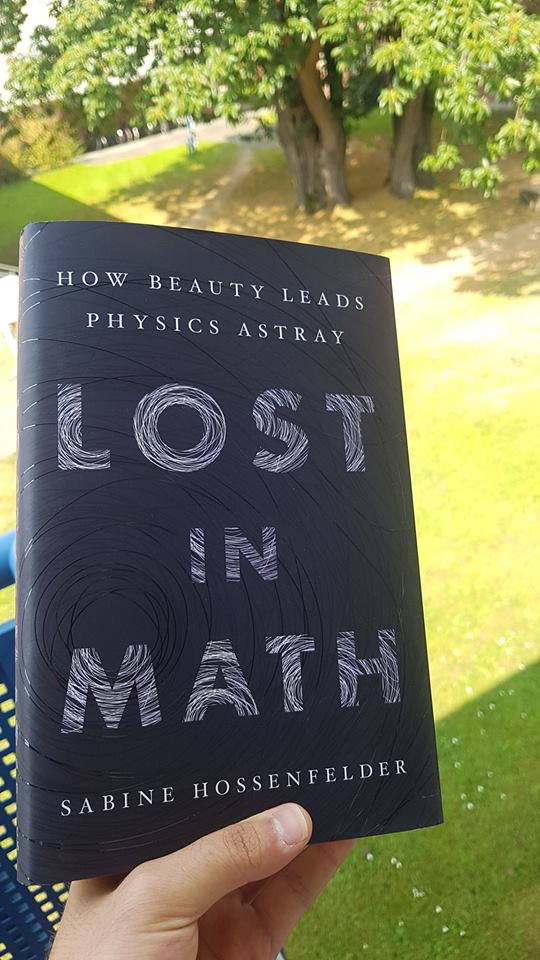
Cover of “Lost in Math”
Physics might be intimidating to many, but to a lot of physicists, it is a search for beauty, elegance, and symmetry. And what about truth ?
“Physical laws should have mathematical beauty”, wrote Dirac on the blackboard on one lecture day. But what exactly did he mean by mathematical beauty ? Beauty in itself is such a vague and personal term, what you would see as beautiful might repel me, and what I see beautiful can be your worse nightmare. But when it comes to science and in particular physics, beauty is what is symmetrical. Patterns, sequences and structures that exhibit order. And this order is seen everywhere around us, from the large scale structures of spiral galaxies to the tiniest ice crystals and lattices and beyond into the subatomic world of particle physics and the Standard Model. And our love for symmetries shouldn’t come as a surprise, after all, we ourselves are roughly symmetric in appearance. But to what extent is nature symmetrical, and is it a right criteria to expect from nature ?
These questions have taken our author of interest, Sabine Hossenfelder, a theoretical physicist in the field of particle physics at the university of Frankfurt, into the depth of these philosophical questions, which we shall be diving into in this short essay.
Symmetry and Relationship to Physics

“The mathematical sciences particularly exhibit order, symmetry, and limitation, and these are the greatest forms of the beautiful”- Aristotle. It seems that this mysterious connection between beauty and symmetry to science has always been realized ever since the ancient Greeks. But why is this connection so intriguing to us ? Well besides “beauty”, this connection has become of vital importance in physical practice, and this was first proven by the mathematician Emmy Noether (1918), when she published a paper under the title “Invariante Variationsprobleme” in which she discussed this deep connection of symmetry and physics, showing that for every symmetry present in nature, there exist a conserved physical quantity.
A translational symmetry means conservation of linear momentum, a rotational symmetry means conservation of angular momentum, even Einstein used this idea to relate time translational symmetry to the conservation of energy. This mysterious connection has finally found physical grounds, symmetry –> conservation law. This has become known as “Noether’s theorem”. This mathematical theory has made contributions to various fields of physics, from particle physics to cosmology. After this realization, physicists tried to dig in deeper into this mysterious connection, finding more symmetries in nature, and this has led to the development of an entire field of mathematics, “Group Theory”, which is a discipline of mathematics focused on studying different group structures and their properties. In other words, we started organizing our theories, putting them into groups and found connections among these groups, and in return, the theories.

Credit: Symmetry Magazine
To give an example, one of the simplest groups in physics is the SO(n) group, which
is the group of rotations in n-dimensions. So given any kind of rotation by an angle X, this rotation has to belong to this SO(n) group, and by studying the properties of this group, one can extract information about the physical system under study. Another complicated example is the Standard Model, which is the model that describes subatomic particles and their interaction such as quarks and gluons. This model obeys a symmetry, and belongs to the U(1)x SU(2)x SU(3) group.
Even cosmological model such as the AdS (Anti-deSitter Spaces) in 3-dimensions belongs to a symmetry group (known as the gauge group) SO(2,2). And basically all the models and theories we work with today, have a symmetry group that they belong to. So as we can see, this association we have done between physical systems and symmetries has served us a huge advantage, we are now able to find order in our systems, and through order comes simplicity.
The author mentions several triumphs where our theories were correct being motivated by aesthetic criteria. One of these triumphs is the story of the Higgs Boson. For many decades, the Standard Model was incomplete, one of the reasons physicists knew that, is because the symmetry group the model belongs to was incomplete, there seemed to be a missing piece of the puzzle, only with it, will the symmetry be achieved. So physicists went for a hunt, a search for this mysterious puzzle piece that they called the “God Particle”; known today as the “Higgs Particle”. It took scientists nearly five decades, and billions of euros to build the Large Hadron Collider (LHC), a particle accelerator that smashes atoms together at nearly the speed of light to study what they are made up of, and there it was, the long sought of “God Particle”. The particle has been found, the symmetry group is now complete, and the beauty we wanted to see is now evident.
Today, there are still a lot of questions left unanswered, one of which is dark matter, the mysterious matter in outer space that makes up nearly 30\% of all the matter in the universe, yet it has never been detected. So physicists again are onto the hunt, using the same approach they used to find the Higgs particle, that is, symmetry criteria. Today a lot of physicists bet their career on what is known as “Supersymmetry” or (SUSY) for short. SUSY tells us that for every particle present in the Standard Model, there exist a super symmetric partner. For example, an electron has a super symmetric partner called the selectron (“s” as in super), and so on. SUSY belongs to a bigger symmetry group called the SO(10), which physicists expect to be a symmetry of nature. So far, no supersymmetric particles have been detected, and what seemed to be a guidance, beauty, is no longer in grasp.
Hossenfelder’s Criticism
In this section we come back to the author’s point of view, and her criticism of today’s scientific community as they follow this beauty criteria.
Early in the book, the author says: “What failed physicists wasn’t their math; it was their choice of math. They believe that Mother Nature was elegant, simple and kind about providing clues (…) Now Nature spoke, and she said nothing loud and clear.” And of course here the author is pointing out about the huge amount of money that was invested to test theories that were based on beauty criteria, from upgrades of the LHC to satellites that were into space, however, non showed anything new.
Before, the scientific method was different, we used our observation and try to make sense out of them, write down equations that describes the phenomena and build models that fits the data. We then realized that there exists symmetries in the model we’ve built, and elegant equations that are simple to describe. Today on the other hand, it’s the other way around, the tables have turned. We are now assuming that our model should be symmetric, and from this criteria, we are trying to write down our equations accordingly. Remember that having symmetric models makes life easier, and equations are simpler to deal with. But why should our universe care what we find beautiful ? why should it be elegant ? Hossenfelder emphasizes that there is a cognitive bias, a trap that scientists are falling in. We are taking sides, believing that our universe should be beautiful because we want it to be so. But the universe should not care how we want things to be. A true scientist should accept the laws of nature even if they were ugly. A true scientists should describe nature the way it truly is, devoid of any human intervention. And this is another issue the author tackles to criticize quantum mechanics. The author quotes from Weinberg:” What I don’t like about quantum mechanics is that it’s a formalism for calculating probabilities that human beings get when they make certain interventions in nature that we call experiments. And a theory should not refer to human beings in its postulates.” Here the author is attacking the Copenhagen Interpretation of quantum mechanics, seeing it as a “shut up and calculate” theory without actually knowing the full story.
Conclusion and Solution
From the start of the book, the attitude of the author is obvious. Physicists are not on the right track, we are being misled, wasting money, time, and leading to confusion through our pre-cognitive ideas and biases, and science is turning into beliefs when it shouldn’t be. Hossenfelder, after a lot of criticism and distrust in the scientific community, offers the reader with solutions. Whether you are a scientist, a policy maker, or a member of the public, you can make a difference. For scientists at least, they should avoid cognitive biases, and beware of the influence of media and social networks, after all, we do tend to follow what is trending without giving it a second thought, as Michael Krämer from Aachen University said:“I think I started working on SUSY because that’s what people worked on when I was a student, in the mid- to late nineties,” Additionally, scientists should build a culture of criticism, and be as skeptical as they can be and ready to say no without any hard feelings.
We should build science and seek for truth, not build cults and seek for a social status.


 Ali Lezeik
Leave a reply to the #1 Itinerary Cancel reply